
Knowledge Centre
Don’t Over Diversify
November 2026
Most people have heard financial experts talk about the benefits of diversification, but it can go too far. Diversification attempts to reduce risk by investing across different sectors, industries or even countries. While diversification is a prudent strategy, there is no guarantee against loss and even the most diversified portfolios cannot reduce the risk level to zero. Some investors have the misguided view that risk is reduced with each additional stock added to a portfolio. Evidence shows that risk (as measured by the standard deviation of returns) can only be reduced to a certain point beyond which there is little further benefit from diversification. It is fairly straightforward to calculate the point at which adding more stocks to a portfolio ceases to eliminate market risk relative to all the stocks in the market.
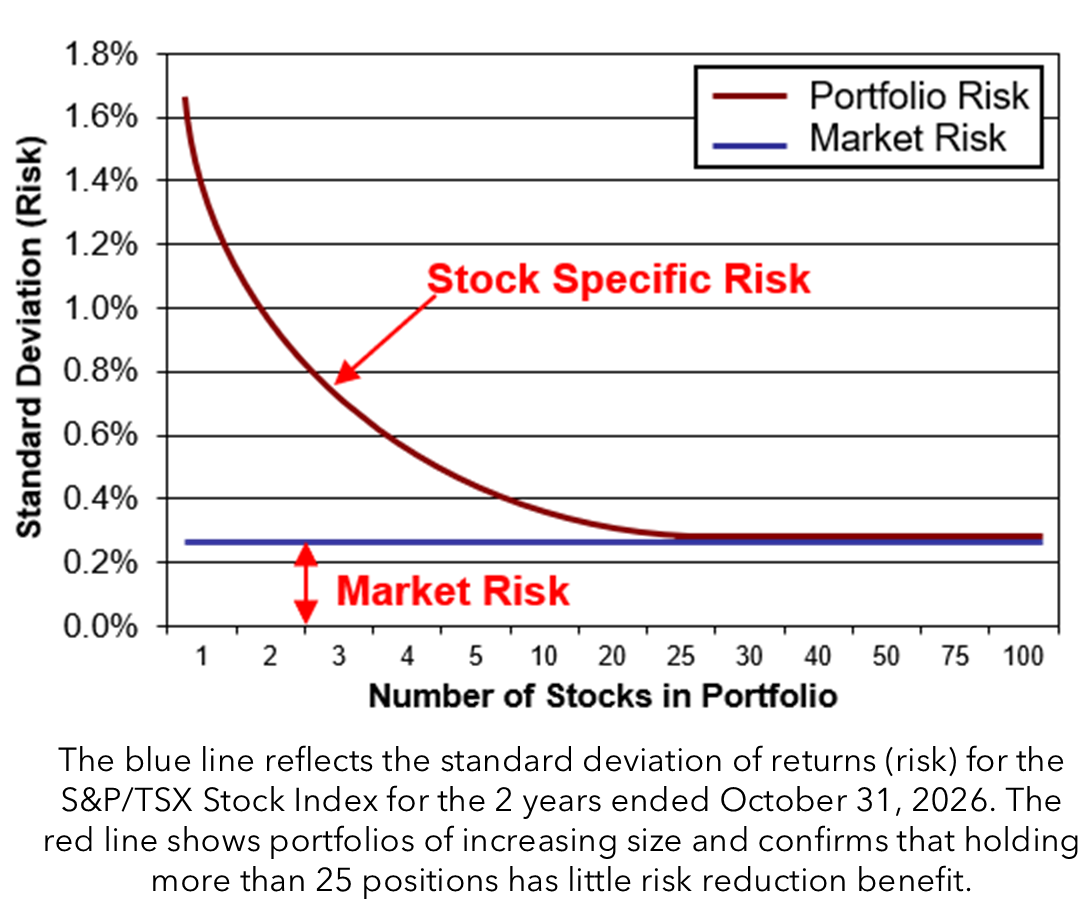
Systematic risk is the general ebb and flow of the market, basically the tendency for all stocks to move up or down as a group over time. Systematic risk cannot be eliminated. Non-systematic risk is the risk associated with individual stocks and can be decreased with diversification. The question is how many stocks should be held to essentially eliminate non-systematic risk? Most research tends to suggest that 20 to 25 securities per asset class are enough. Adding more securities can also be futile as the prospects for the incremental positions may not be as rosy. Anything beyond 20 to 25 positions per class can also reduce the long term rate of return due to increased expenses, trading costs, transaction fees, and taxes; all of which can erode your investments.
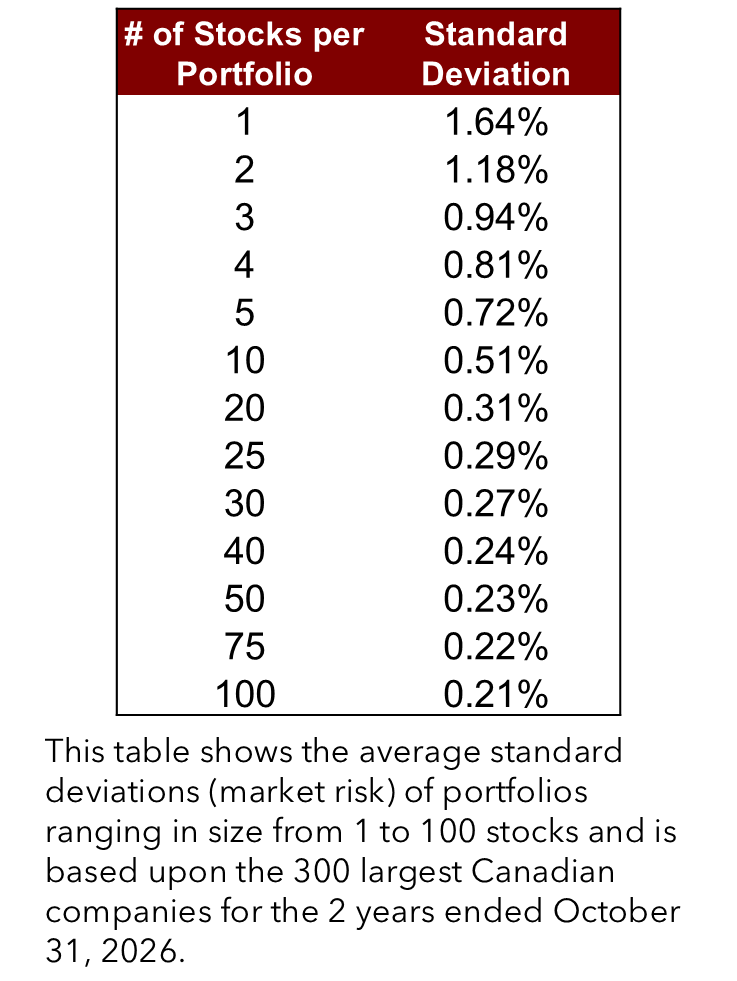
Over-diversification is likely one of the more significant reasons that many professional managers underperform their targeted benchmark after fees. The data to the left indicates the average standard deviation, which represents market risk, of a Canadian one stock portfolio was 1.64% relative to the average daily volatility for the 300 largest stocks in Canada for the 2 years ending October 31, 2026. Increasing the number of positions in a well balanced portfolio could reduce the portfolio's standard deviation to about 0.20%. Note that a portfolio of 20 to 25 stocks reduces the risk to about 0.29% but going from 25 to 300 positions only reduces risk by about 0.09%. Therefore, the first 25 stocks reduced the portfolio's risk by 1.35% (from 1.64% to 0.29%) or 93% of the non-systematic risk.
Sometimes investors overly complicate their investing and make it harder than it should be. Diversification is a great tool because it is a simple, smart and an important way to reduce portfolio risk. All long term investors should make sure their level of diversification is appropriate. Proper diversification allows investors to focus on choosing the best investments and avoid the needless effort of having to manage far too many holdings.
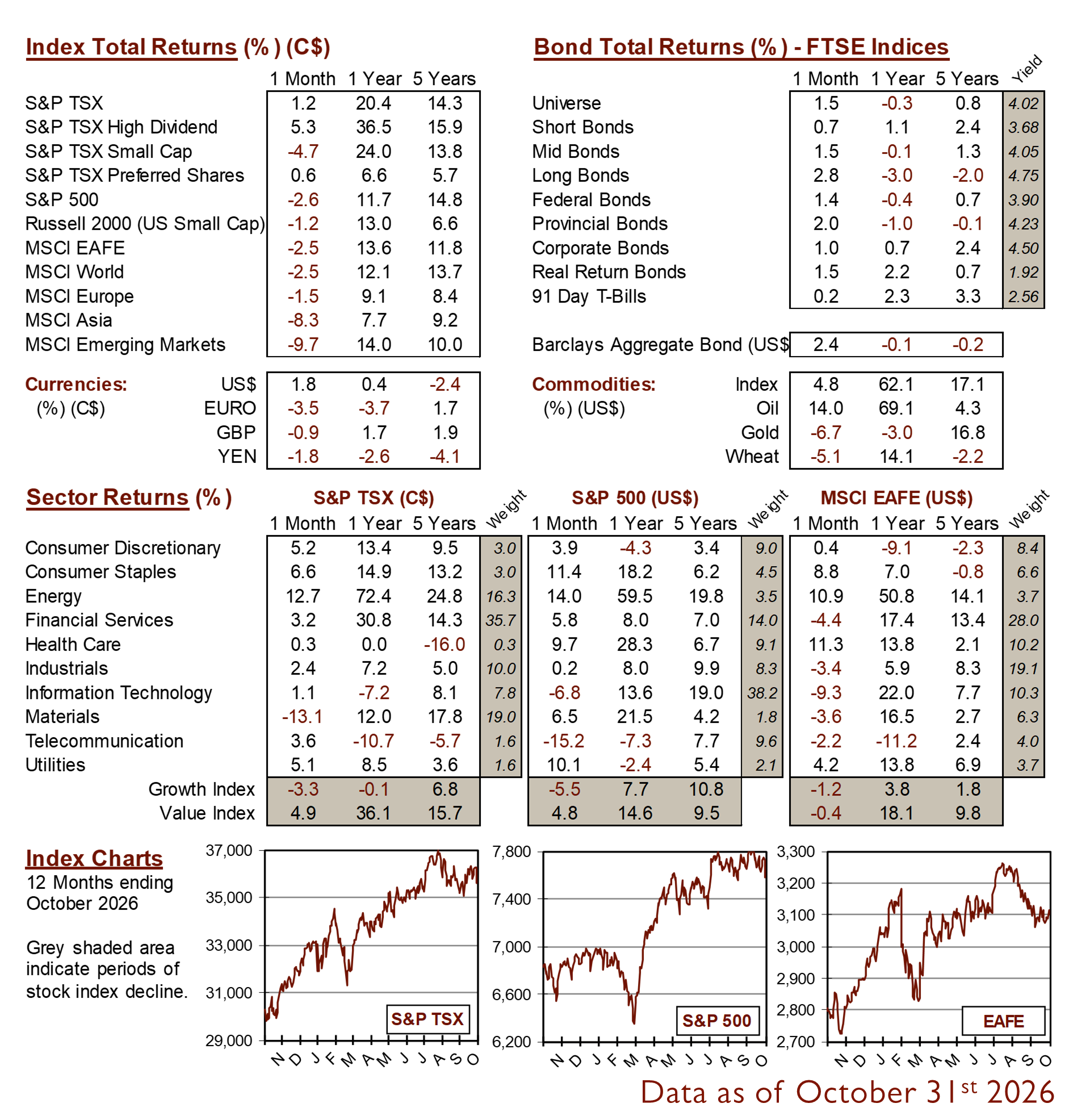
MARKET DATA
This report may contain forward looking statements. Forward looking statements are not guarantees of future performance as actual events and results could differ materially from those expressed or implied. The information in this publication does not constitute investment advice by Provisus Wealth Management Limited and is provided for informational purposes only and therefore is not an offer to buy or sell securities. Past performance may not be indicative of future results. While every effort has been made to ensure the correctness of the numbers and data presented, Provisus Wealth Management does not warrant the accuracy of the data in this publication. This publication is for informational purposes only.
Contact Us
"*" indicates required fields
18 King St. East Suite 303
Toronto, ON
M5C 1C4